MetaWin provably fair mechanics explained
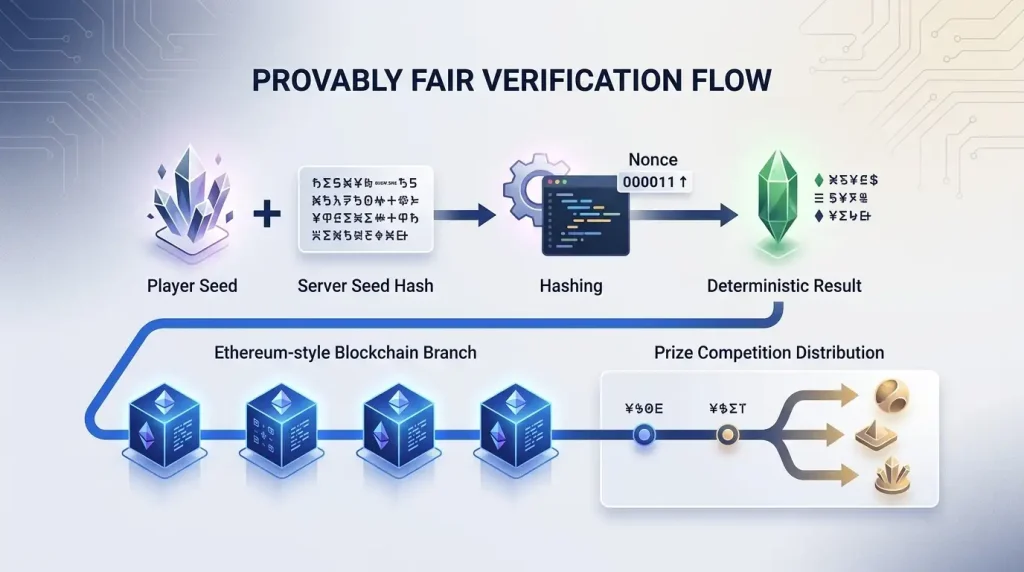
Table of Contents
- Provably fair is an integrity check for a game result
- A typical seed-and-hash verification flow has four stages
- Server seed, client seed and nonce solve different parts of the verification problem
- A round-level fairness check does not establish RTP, house edge or platform-wide safety
- On-chain prize competitions use a different verification path
- Use the verification panel like an audit trail, not a badge
- Questions readers usually ask
- Provably fair is most useful when you can reproduce the full result path
Section element
OUTCOME VERIFICATION
MetaWin Originals are described as provably fair, while the brand’s on-chain prize competitions use Ethereum smart contracts for a separate kind of verification. The useful question is not whether cryptography appears somewhere in the product, but exactly what a given verification step can and cannot prove.
Section element
- MetaWin OriginalsProvably-fair functionality is used in MetaWin Originals
- Prize competitionsEthereum smart-contract outcome handling
- Verification scopeIndividual outcome integrity
- Not established by fairness aloneHouse edge, RTP or platform-wide safety
Provably fair is a narrow technical claim. It is strongest when you can reproduce a result from the same committed inputs the game used. It becomes weaker as soon as the calculation, inputs or mapping from hash to result are hidden.
Provably fair is an integrity check for a game result
MetaWin Originals are identified as using provably-fair mechanics. In practical terms, that means a player can verify that a result follows a precommitted cryptographic process instead of accepting the displayed outcome on trust alone.
Commitment before play
A provably-fair design normally commits to secret data before the round. A cryptographic hash can act as that commitment because changing the underlying value later would change the hash.
Player-side or round input
A second input can come from the player or from a round counter. This prevents a single hidden value from determining every outcome in an opaque way.
Reproducible result
After the hidden value is revealed, the same calculation should reproduce the outcome. That is the core verification test.
The MetaWin Originals guide separates this fairness mechanism from Zero House Edge games and from on-chain prize competitions so the terms do not blur together.
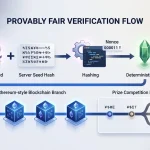
A typical seed-and-hash verification flow has four stages
- Commit: the game publishes a cryptographic commitment to a server-side value before the result is finalized.
- Combine: the game uses that server-side value with another input such as a client seed and a round counter or nonce.
- Generate: those inputs are processed through a deterministic calculation that maps them to a game result.
- Reveal and check: the previously hidden server-side value is disclosed so the player can hash it and reproduce the round calculation.
This is a general explanation of how provably-fair systems commonly work. MetaWin describes provably-fair functionality for Originals, but does not specify every interface field, hash function or game-by-game formula. Those details need to come from the actual game’s verification panel when available.
A successful check
- The revealed server-side value matches the earlier commitment.
- The client-side input and round number match the played round.
- Repeating the stated calculation produces the displayed result.
An incomplete check
- You can see a hash but not the value it commits to.
- You can see seeds but not the mapping from hash output to game result.
- You can verify one stage but not the full calculation chain.
Server seed, client seed and nonce solve different parts of the verification problem
| Input | Typical role | What to verify |
|---|---|---|
| Server seed | Secret value committed before play | The revealed seed hashes to the earlier commitment |
| Client seed | Additional input that can give the player influence over the final data set | The same client seed was used for the round being checked |
| Nonce / round counter | Separates repeated rounds using the same seed pair | The round number matches the game history |
| Result mapping | Turns cryptographic output into a card, dice value, multiplier or other outcome | The published mapping reproduces the displayed result |
The terminology is useful because each input closes a different gap. A server-seed commitment helps prevent retroactive changes. A client seed can reduce dependence on a single operator-controlled input. A nonce makes repeated rounds distinct. The mapping rule connects the cryptographic output to the visible game.
None of those terms should be treated as a MetaWin-specific interface guarantee unless the selected Original actually exposes them. They are the standard components to look for when checking a provably-fair implementation.
A round-level fairness check does not establish RTP, house edge or platform-wide safety
Provably fair answers one question: did this round follow the committed cryptographic procedure? It does not automatically answer how favorable the payout table is or what the expected return looks like over a long session.
- Outcome integrity
- Provably-fair verification can test this when the required inputs and formula are available.
- House edge
- This depends on the game’s payout structure and probabilities, not on the mere presence of hashes or seeds.
- RTP
- A single audited catalogue-wide RTP is not established here.
- Platform-wide safety
- Game-result verification does not evaluate custody, withdrawals, account review or operational risk.
This distinction matters for MetaWin because the brand also has a separate Zero House Edge Originals category. “Provably fair” and “Zero House Edge” are not synonyms: one describes result verification, while the other is a product label tied to a specific set of games.
For operator and dispute context, use the separate MetaWin license page. Keeping that topic separate prevents a cryptographic game check from being mistaken for a broader platform assessment.
On-chain prize competitions use a different verification path
MetaWin also runs on-chain prize competitions with outcomes handled through Ethereum smart contracts. That creates a public blockchain trail for the competition mechanism, but it is not the same as checking a casino Original through seeds and hashes.
Provably-fair game check
You reproduce an individual casino outcome from committed cryptographic inputs and the game’s calculation.
On-chain competition check
You inspect smart-contract activity and blockchain records tied to the prize event.
These two methods can coexist under the same brand because they verify different things. The first tests an in-game random-result process. The second exposes contract-driven activity for a separate prize competition.
Blockchain visibility can make an event easier to inspect, but the meaning still depends on the contract and event rules. A transaction record proves that a transaction occurred; understanding the competition still requires knowing what the contract was designed to do.
Use the verification panel like an audit trail, not a badge
- Confirm that the game exposes a pre-round commitment or equivalent cryptographic reference.
- Record the client-side input and round number if the interface makes them available.
- After the round, compare the revealed value with the original commitment.
- Reproduce the stated calculation instead of stopping at a matching hash.
- Check how the cryptographic output maps to the visible game result.
- Separate fairness verification from payout value, promotion eligibility and cashout mechanics.
If a verification panel provides only a green badge or a final hash without enough data to reproduce the round, the check is informational rather than independently complete. A useful verifier should let you follow the chain from commitment to result.
The broader MetaWin games guide places Originals next to live casino, slots and other categories, while the Originals page covers Zero House Edge and prize-competition distinctions in more depth.
Questions readers usually ask
Are MetaWin Originals provably fair?
MetaWin Originals use provably-fair mechanics. Outcome verification is possible where the game exposes the required cryptographic inputs.
What does provably fair actually prove?
It can show that an outcome follows the committed cryptographic inputs and stated calculation. It does not prove that the game has no house edge, that every payout rule is favorable, or that the platform as a whole is risk-free.
What are server seeds, client seeds and nonces?
They are common components in provably-fair systems. A server seed is typically committed before play, a client seed adds player-side input, and a nonce distinguishes repeated rounds. The exact fields and verification steps can vary by game, so use the verification data shown in the selected Original.
Are MetaWin prize competitions checked the same way as casino Originals?
No. MetaWin also uses Ethereum smart contracts for on-chain prize competitions. That is a separate verification path from the cryptographic fairness checks used for casino game outcomes.
Does provably fair mean zero house edge?
No. Provably fair and house edge answer different questions. MetaWin has a separate Zero House Edge Originals category, but outcome verifiability alone does not establish a zero edge.
Provably fair is most useful when you can reproduce the full result path
MetaWin Originals use provably-fair mechanics, and MetaWin’s prize competitions add a separate Ethereum smart-contract layer. The practical standard is simple: verify the committed input, reproduce the calculation and keep that technical check separate from questions about payout value, house edge or platform operations.
MetaWin games span major studios, live tables and its own Originals

MetaWin live casino providers and game coverage
MetaWin Section element LIVE DEALER CATALOGUE MetaWin’s live section is built around established third-party studios...
MetaWin Originals, Zero House Edge and prize competitions
MetaWin Section element IN-HOUSE GAMES AND ON-CHAIN MECHANICS MetaWin Originals are a separate in-house game...